
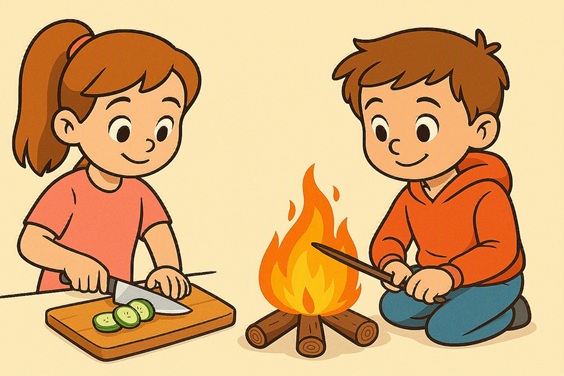
I was speaking recently with a colleague and friend when the conversation turned to our children. At some point, I shared a story about when my sons were young and our family spent a great deal of time camping together. Like many camping families, we cooked over open fires. We carried pocketknives and used larger knives for food preparation and various camp chores. Knives and fire were simply part of the experience.
As I described those years, I explained that my wife and I taught our boys to respect the danger of knives and fire and took the opportunity to teach them responsibility. We talked about what knives were used for, how they should be carried and handled, and what could happen if someone became careless or distracted. We demonstrated, supervised, answered questions, and gradually allowed greater independence as they showed they could handle it. We took much the same approach with fire. We taught them how quickly things could go wrong, what behavior was expected around a fire, and what responsibilities came with participating. As they demonstrated judgment and self-control, we entrusted them with more responsibility.
After hearing the story, my colleague smiled and said, “Well, you have very mature kids.”
I appreciated the compliment. At the same time, her comment lingered in my mind because it seemed to imply that my children were simply born that way. As if their maturity was largely a matter of nature rather than something that had also been shaped by years of intentional parenting. It got me thinking about a question I encounter frequently in my work with enterprising families: How much of who our children become is nature, and how much is nurture?
Anyone who has raised more than one child knows that nature matters. Children arrive with different temperaments, personalities, strengths and challenges. Siblings raised in the same home, with the same parents, values, opportunities and expectations, often develop in very different ways. Some seem naturally cautious and responsible. Others appear wired for adventure and risk-taking. Some embrace responsibility early, while others take longer to develop the same capacities.
At the same time, I find it difficult to believe that parenting has little influence. My wife and I intentionally looked for opportunities to help them develop judgment and responsibility. We gradually increased expectations as they demonstrated readiness and tried to create experiences that required them to think, contribute, solve problems and manage increasing levels of freedom. Would they have become mature adults without those experiences? Perhaps. We will never know. But I believe it is far too simplistic to conclude they would have ended up exactly the same regardless of how they were raised.
Thinking about this conversation reminded me of one of the most common questions I hear from financially successful families: “When should we give our children money?” Sometimes the question concerns trusts, inheritances or ownership interests. Sometimes it involves governance responsibilities, family foundations or leadership roles. Yet underneath all these questions is usually a more fundamental one: “When are they ready?”
The similarity to knives and fire strikes me as obvious. Knives are powerful tools. Fire is a powerful tool. Money is a powerful tool. None of them are inherently good or bad. In capable hands, they can create wonderful outcomes. In unprepared hands, they can create significant problems. Most parents would never hand a young child a sharp knife, walk away, and hope for the best. Yet families sometimes approach wealth differently, transferring significant financial responsibility based primarily on age, predetermined schedules or family tradition.
The challenge, of course, is that readiness and age do not easily line up. One child may be prepared for significant responsibility earlier than expected, while another may require more time, structure and support. The same family, providing the same nurturing environment, can produce very different outcomes.
Over the years, I have come to believe that parents need to provide intentional nurture by teaching values, creating opportunities for responsibility, and helping children develop character and judgment while meeting the child where they are developmentally. Different children may require different timelines, different levels of support, and different opportunities.
I’m grateful for the opportunity my colleague’s comment gave me to reflect on my parenting choices.
When families ask me when children should receive money, ownership or greater responsibility, I often think back to those camping trips. The most important question I encourage families to think about is whether the choices they make help prepare the next generation to use it wisely.